
You can repair a minor split nail by cleaning it, trimming or filing the loose edge, and protecting the crack with a bandage or temporary nail wrap while it grows out. However, a split that reaches the pink attached part of the nail, causes bleeding, or exposes the skin underneath needs wound care rather than a cosmetic repair.
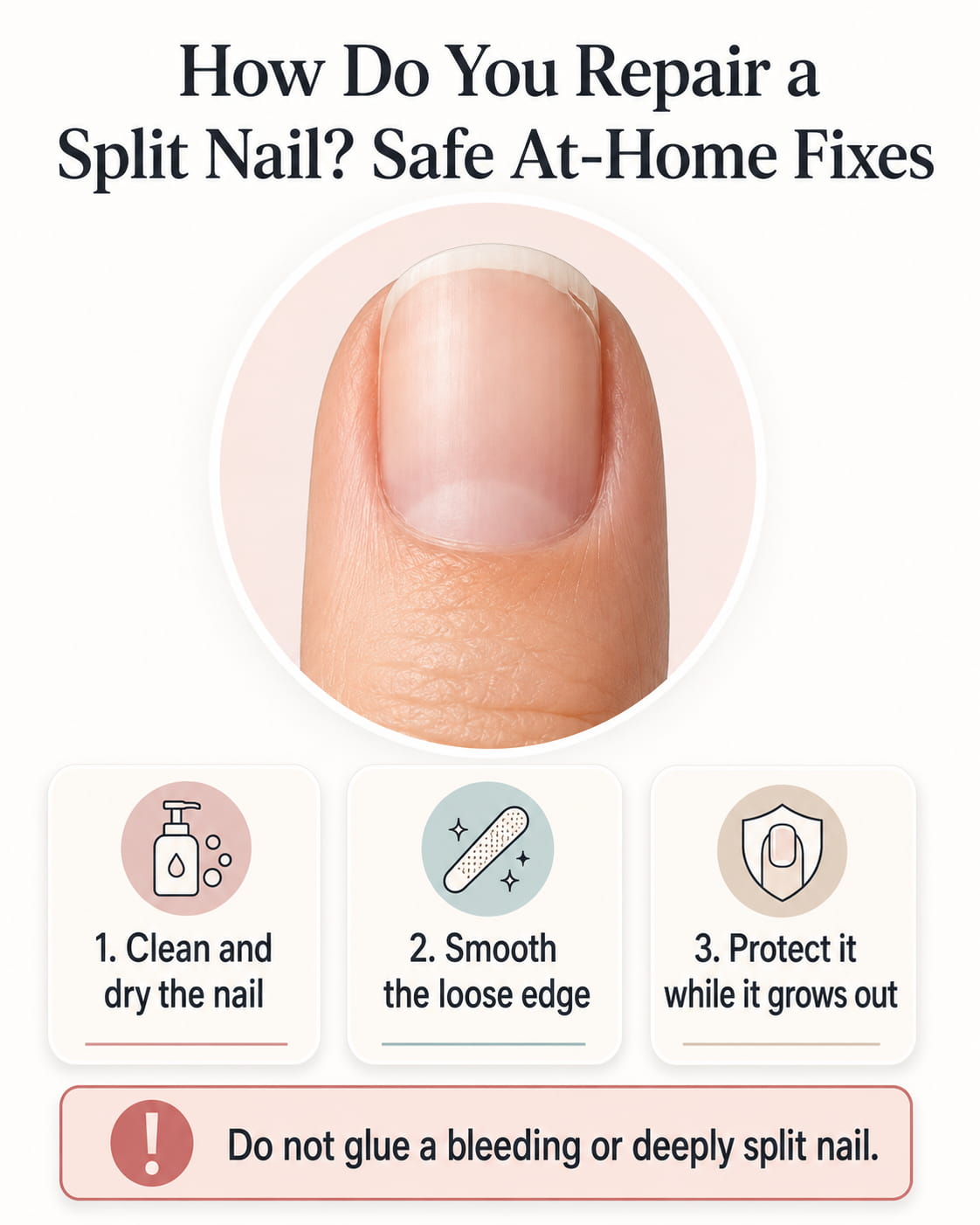
The damaged nail plate cannot permanently fuse back together. Any tea-bag patch, silk wrap, or nail adhesive simply holds the split in place and prevents snagging until healthy nail growth pushes the damaged section forward.
How Do You Repair a Split Nail Safely?
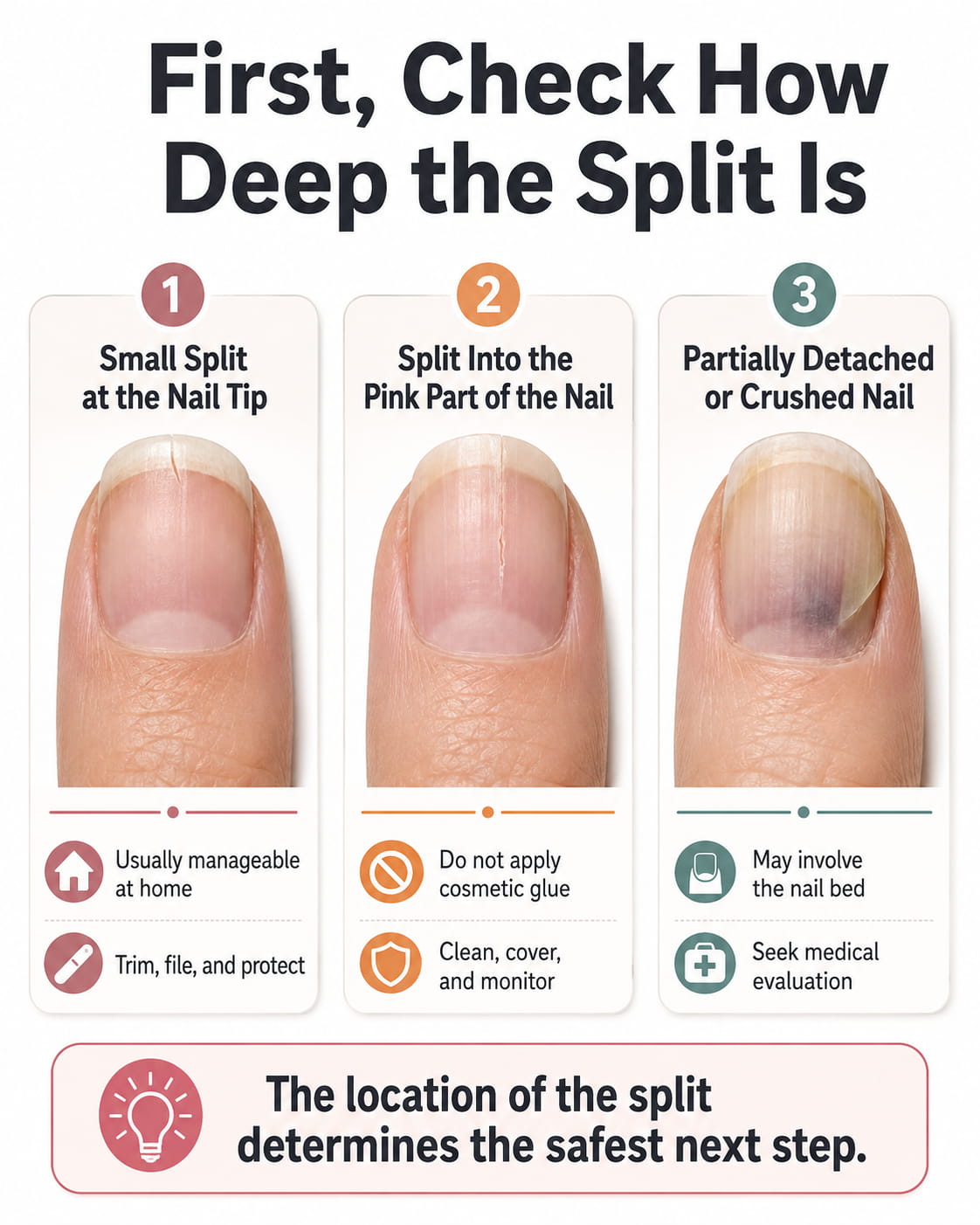
First, check where the split ends. The location determines whether you can manage it at home or should seek medical care.
| Type of split | Recommended action |
|---|---|
| Small, painless split at the white tip | Trim or file the loose edge and protect it |
| Shallow crack in the hard nail plate | Consider a temporary tea-bag or silk-wrap patch |
| Split extending into the pink attached nail | Clean, cover, and treat it as an injury |
| Bleeding, severe pain, or exposed nail bed | Seek medical advice |
| Partially detached, crushed, black, or purple nail | Get prompt medical evaluation |
The American Academy of Dermatology recommends trimming only the portion of an injured nail that is no longer connected to the skin. Do not pull off an attached section.
First, Check How Deep the Split Is
Wash your hands and examine the nail in good light. Avoid bending the cracked section while checking it.
Small Split at the Nail Tip
A split limited to the white free edge is usually the easiest to manage. It may catch on clothing or hair but should not cause significant pain or bleeding.
You can usually:
- Clip away an entirely loose corner.
- File the rough edge gently.
- Keep the nail short.
- Cover it temporarily during activities that may cause snagging.
- Apply hand cream or petroleum jelly around the nail to reduce dryness.
Do not cut past the white tip into the pink attached portion.
Split Into the Pink Part of the Nail
A crack that extends into the pink area may involve sensitive tissue beneath the nail. It can be painful even when it is not visibly bleeding.
Do not apply nail glue, polish, acrylic, gel, or a tea-bag patch over this type of injury. Clean it gently, protect it with a light dressing, and avoid pressure on the nail.
Medical evaluation is advisable when the split is deep, painful, widening, or close to the cuticle.
Partially Detached or Crushed Nail
A nail that has lifted away from the nail bed, turned black or purple, or been crushed in a door or other object may have a nail-bed injury or broken bone underneath.
Do not pull the nail off or attempt to drain trapped blood yourself. A healthcare professional may need to examine the nail, control pressure beneath it, repair the nail bed, or check for a fracture.
How to Fix a Minor Split Nail at Home
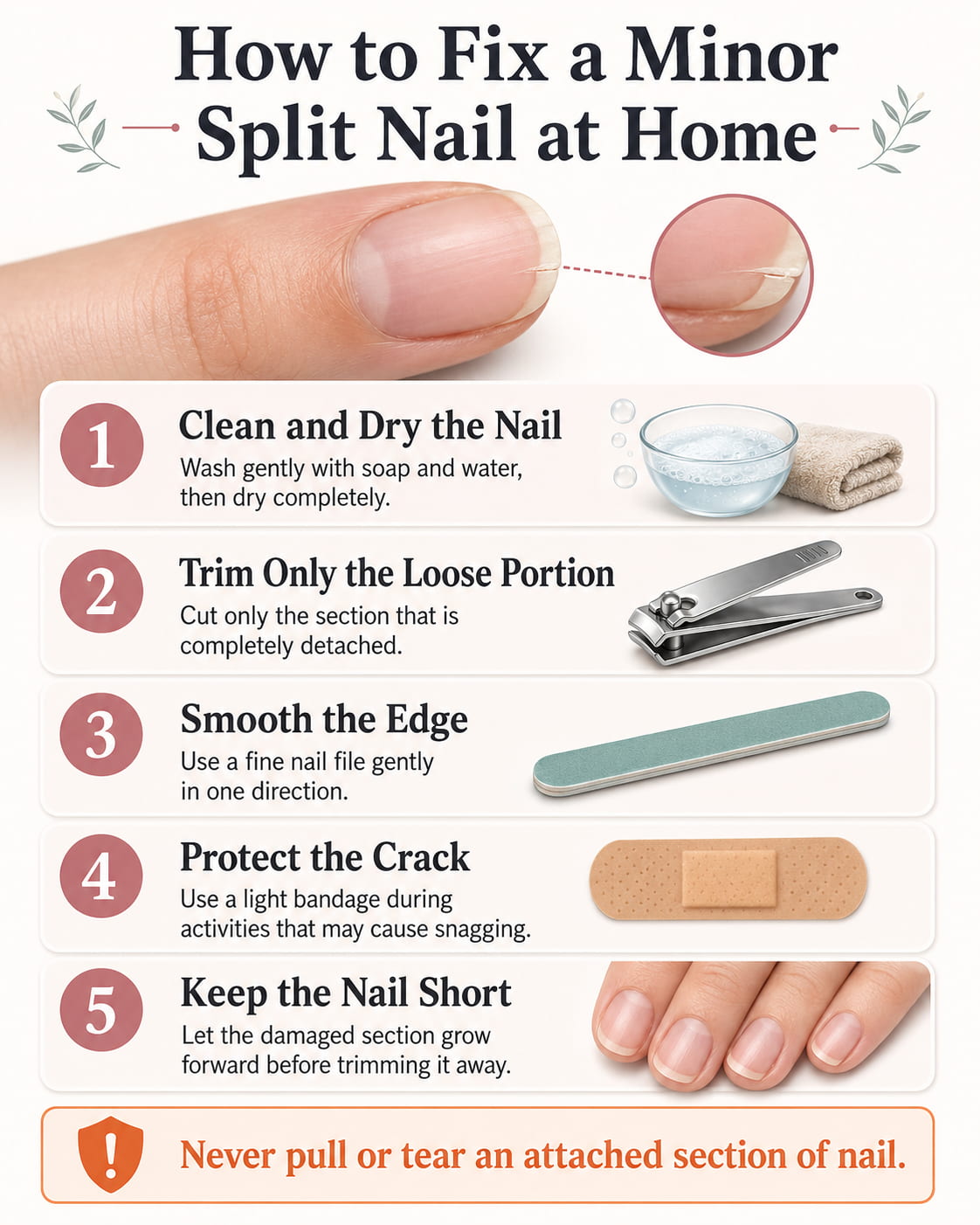
Use this method only for a shallow split at the tip that is not bleeding and does not expose skin.
1. Clean and Dry the Nail
Wash the nail with mild soap and water. Dry it thoroughly, including underneath the free edge.
Moisture trapped beneath a patch can cause it to lift and may irritate the surrounding skin.
2. Trim Only the Loose Portion
Use clean nail clippers to remove an edge only when it is completely detached and can be cut without pain.
Never pull, peel, or tear the cracked section. Pulling can extend the split into the attached nail.
3. Smooth the Edge
Use a fine-grit nail file to smooth sharp areas. File gently in one direction rather than aggressively sawing back and forth.
Avoid thinning the surface of the nail with heavy buffing.
4. Protect the Crack
For a very small split, a lightweight bandage may be enough. Place the adhesive on the surrounding skin rather than directly across a painful or injured nail.
You can also use a finger cot or protective glove while doing housework, gardening, or other activities that could reopen the split.
5. Keep the Nail Short
Continue filing the nail as it grows. Once the entire split reaches the free edge, you can trim it away safely.
How to Repair a Split Nail With a Tea Bag
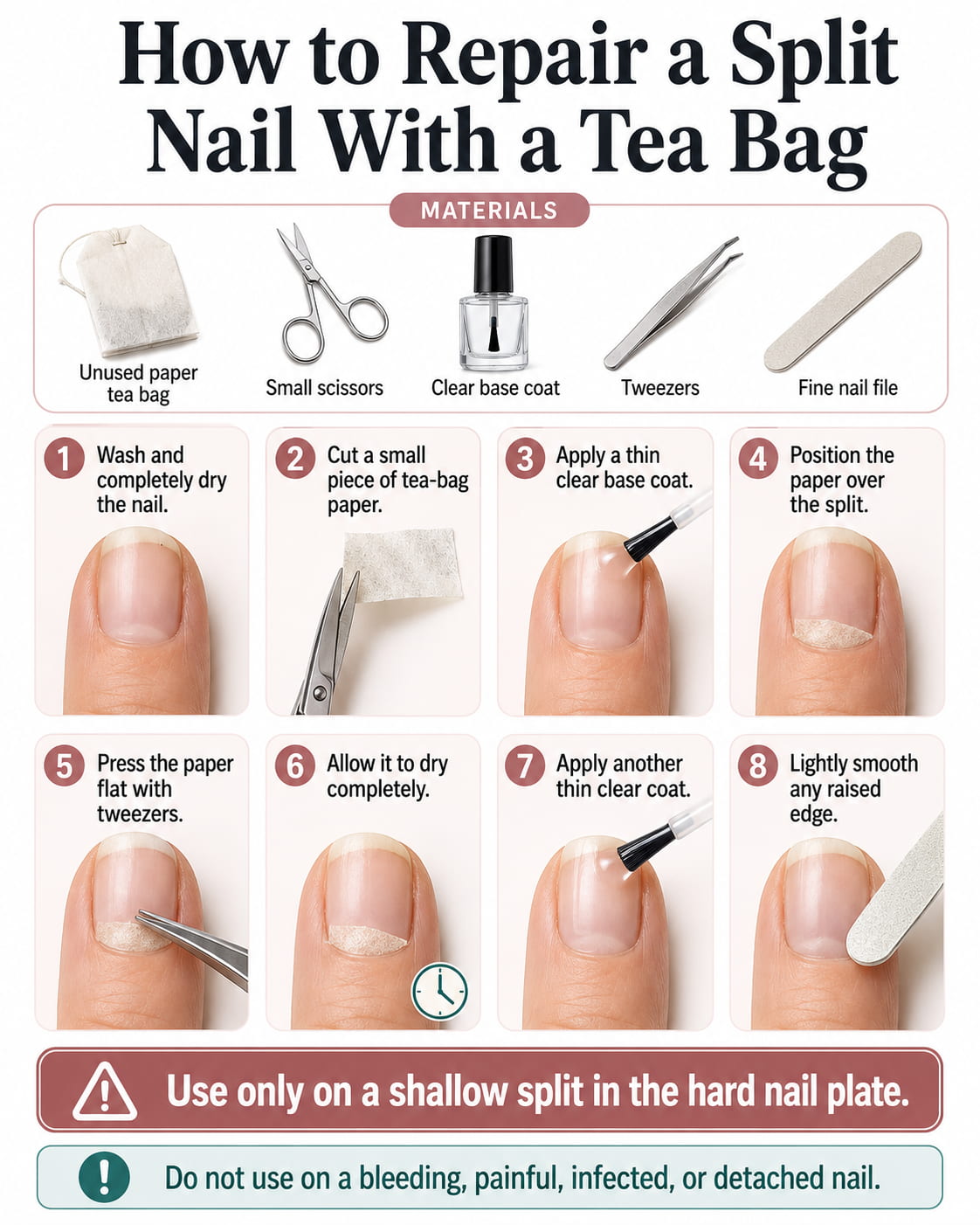
The tea-bag method creates a thin temporary wrap over a superficial crack. It does not heal the nail, but it may prevent a small split from catching and spreading.
Do not use this technique if the nail is bleeding, painful, infected, detached, or split into the pink area.
You will need:
- An unused paper tea bag
- Small scissors
- Clear base coat or clear nail polish
- Tweezers
- A fine nail file
Step-by-Step Tea-Bag Repair
- Wash and completely dry the nail.
- Cut a small piece of tea-bag paper slightly larger than the split.
- Apply a thin layer of clear base coat over the cracked hard nail.
- Use tweezers to position the paper over the split.
- Press it flat without touching an open cut or surrounding skin.
- Allow the layer to dry completely.
- Apply another thin coat over the patch.
- Once dry, lightly smooth any raised edge with a fine file.
- Add one final clear coat if needed.
Check the patch daily. Remove or replace it if it lifts, traps moisture, or causes irritation. Do not peel it off forcefully, as this may remove layers of the natural nail.
A purpose-made silk nail wrap can be used similarly and may be easier to position than tea-bag paper.
How to Repair a Split Nail Without Glue
You do not need glue to manage most minor split nails.
For a small crack, you can:
- Carefully shorten the nail.
- Smooth the rough edge with a fine file.
- Cover the fingertip with a light bandage when necessary.
- Wear gloves for dishes, cleaning, and wet work.
- Avoid using the nail to open containers or scrape surfaces.
- Moisturize the nail and cuticle several times a day.
- Let the damaged area grow forward naturally.
This approach is often preferable for people with sensitive skin, adhesive allergies, or nails already weakened by gel, acrylic, or dip manicures.
Can You Use Nail Glue on a Split Nail?
Cosmetic nail glue may temporarily reinforce a very shallow crack confined to the hard nail plate. However, it should never be applied to exposed skin, a bleeding split, an inflamed cuticle, or a damaged nail bed.
Nail adhesives may contain methacrylates or cyanoacrylates. DermNet explains that these ingredients can cause irritation, allergic contact dermatitis, swelling, blistering, or separation of the nail from the nail bed in susceptible people.
When using any cosmetic nail adhesive:
- Follow the product directions.
- Use the smallest amount necessary.
- Keep it off the cuticle and surrounding skin.
- Stop immediately if you feel burning or itching.
- Do not cover redness, swelling, pus, or discoloration.
- Avoid repeated applications to the same damaged area.
Do Not Use Household Super Glue
Household super glue is not designed for nail or wound care. It may bond skin instantly, cause irritation, and generate enough heat to burn the skin in some circumstances.
If skin becomes accidentally bonded, do not pull it apart. Poison Control recommends allowing the bond to loosen with warm soapy water, petroleum jelly, or oil rather than forcing the skin apart.
Medical-grade skin adhesive is a different product and should be applied only by an appropriately trained professional.
What to Do When a Split Nail Is Bleeding
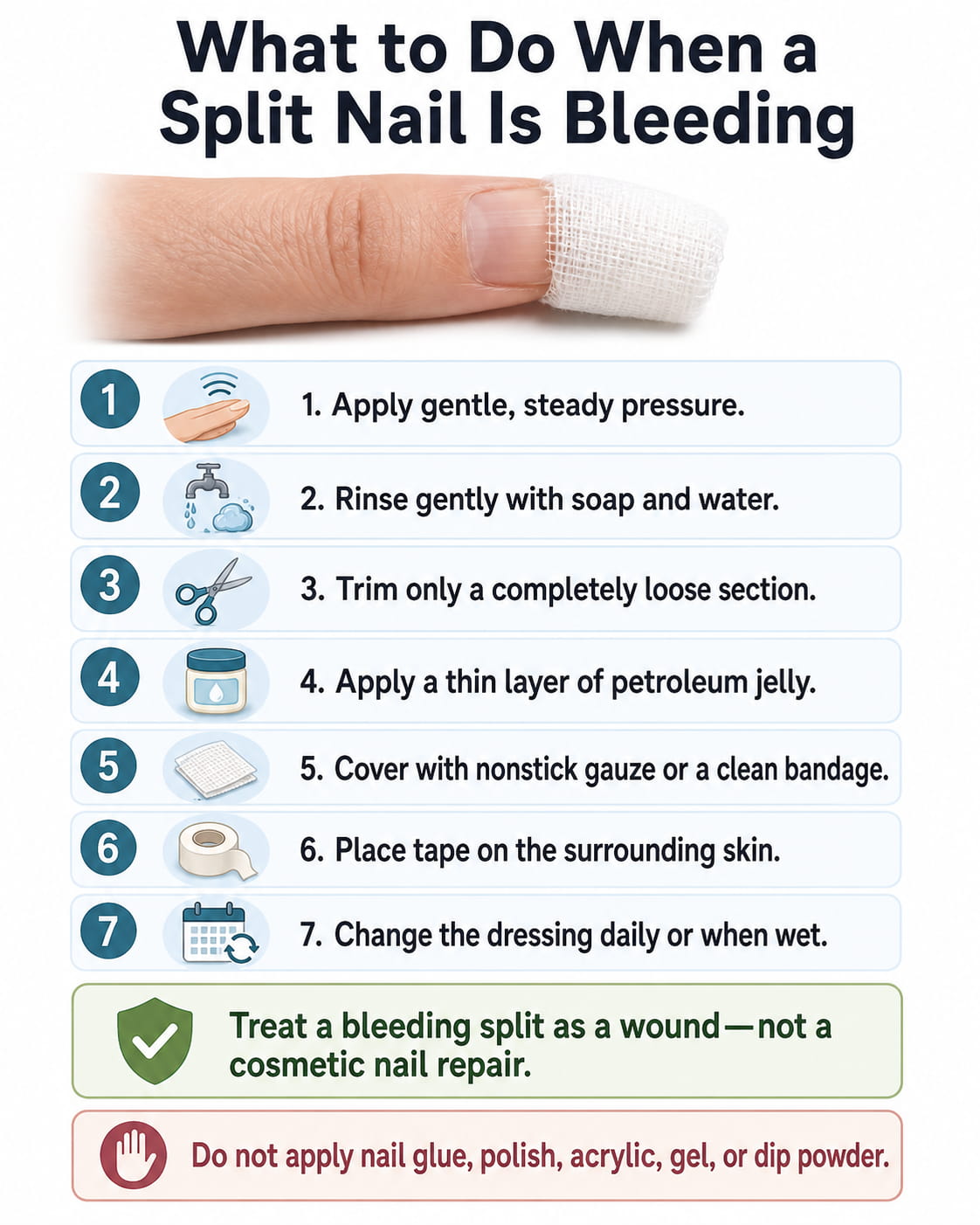
A bleeding split should be treated as a wound, not patched with cosmetic products.
Follow these steps:
- Apply gentle, steady pressure with clean gauze until the bleeding stops.
- Rinse the area gently with soap and water.
- Trim only a section that is completely loose and no longer connected to the skin.
- Apply a thin layer of petroleum jelly.
- Cover the area with nonstick gauze or a clean bandage.
- Attach medical tape to the surrounding skin rather than the injured nail.
- Change the dressing daily or whenever it becomes wet or dirty.
A cool, damp cloth and elevation may help reduce throbbing and swelling after a recent injury. Avoid wrapping the finger or toe so tightly that circulation is restricted.
The American Academy of Dermatology recommends petroleum jelly before covering the injury because dry gauze can stick to the wound.
How Long Does a Split Nail Take to Heal?
The visible crack will not disappear until it grows to the tip and can be trimmed away. A split near the free edge may grow out relatively quickly, while one near the cuticle can take several months.
According to MedlinePlus:
- A replacement fingernail generally takes about four to six months to grow.
- A replacement toenail may take approximately 12 months.
- After complete nail loss, the exposed nail bed may heal in roughly seven to ten days, although nail regrowth takes much longer.
Growth speed varies with age, circulation, nutrition, health conditions, the location of the injury, and whether the nail matrix was damaged.
Why Does the Same Nail Keep Splitting?
Repeated splitting often results from ongoing mechanical damage or dryness rather than a single injury.
Common contributors include:
- Frequent handwashing or sanitizer use
- Repeated wetting and drying
- Cleaning products and solvents
- Long nails that catch or bend
- Nail biting or picking
- Cutting or damaging the cuticle
- Aggressive filing or buffing
- Frequent gel, dip, or acrylic manicures
- Improper removal of artificial nails
- Naturally thin or brittle nails
- Normal age-related nail changes
The American Academy of Dermatology notes that artificial-nail preparation and removal can thin natural nails and leave them brittle, dry, or prone to cracking.
Persistent splitting may occasionally be associated with nail fungus, eczema, psoriasis, thyroid problems, iron deficiency, or another health condition. A recurring split in exactly the same location can also indicate repeated injury or damage near the nail matrix.
Avoid starting supplements solely because of a split nail. A clinician can determine whether testing is appropriate based on your symptoms, diet, medications, and medical history.
How to Prevent Split Nails
A few practical habits can reduce future cracking:
- Keep nails short enough that they do not bend or catch.
- File small snags before they become larger splits.
- Apply a thick, fragrance-free hand cream after washing.
- Massage petroleum jelly or cuticle oil around dry nails at bedtime.
- Wear waterproof gloves for dishes and cleaning.
- Consider cotton-lined gloves for prolonged wet work.
- Avoid using nails as tools.
- Do not bite or peel damaged nail layers.
- Leave cuticles intact because they help protect against infection.
- Limit acetone exposure when nails are dry or brittle.
- Take breaks between gel, dip, and acrylic manicures.
- Have artificial nails removed gently rather than peeling them off.
- Disinfect personal nail tools and do not share them.
When to See a Doctor or Dermatologist
Seek medical care when:
- The split reaches deeply into the pink attached nail.
- The nail is partly or completely detached.
- Bleeding does not stop with firm pressure.
- Pain is severe, throbbing, or worsening.
- Blood covers more than half of the nail.
- The nail turns black or purple after an injury.
- You cannot bend the affected finger or toe normally.
- A crush injury or broken bone is possible.
- The cuticle or nail bed has a deep cut.
- Redness, warmth, swelling, or tenderness increases.
- Pus or another unusual discharge appears.
- You develop a fever.
- The injury is not improving after several days.
- The same nail repeatedly splits without a clear cause.
- A new brown or black streak appears without a known injury.
People with diabetes, poor circulation, nerve damage, or a weakened immune system should seek medical guidance sooner, particularly for a toenail injury or signs of infection.
Frequently Asked Questions
Can a split nail heal itself?
The cracked nail plate cannot fuse back together. The split must grow forward until it reaches the tip and can be trimmed away. A patch only protects the damaged area during this process.
Should you cut off a split nail?
Cut only the portion that is completely loose and no longer attached to the skin. Do not cut into the pink area or pull off a section that remains attached.
Does the tea-bag nail repair work?
It can temporarily reinforce a shallow crack in the hard nail plate and reduce snagging. It does not medically heal the nail and should not be used on a bleeding, painful, infected, or detached nail.
Can you put nail glue on a split natural nail?
Cosmetic nail glue may be used cautiously on a minor surface crack, but it should not touch exposed skin or an open wound. Avoid it if you have experienced reactions to nail adhesives or artificial nails.
How do you fix a nail split down the middle?
A split limited to the white tip may be shortened, filed, and protected. A central split extending into the pink attached nail should not be glued. Protect it with a dressing and seek professional advice if it is deep, painful, or widening.
How long does a cracked fingernail take to grow out?
A complete fingernail generally takes four to six months to replace itself. A crack near the tip may be trimmed away sooner, while one near the base may require most of the full growth period.
Why does one fingernail keep splitting?
Repeated pressure, picking, dryness, chemical exposure, or damage near the nail base may affect one nail more than the others. See a dermatologist if the splitting continues despite careful nail protection or is accompanied by pain, discoloration, thickening, or skin changes.
Conclusion
Most minor split nails can be managed by trimming the loose edge, smoothing the crack, and protecting it while it grows out. A tea-bag or silk wrap may provide temporary support when the split is shallow and the skin remains intact.
Do not glue a bleeding or deeply cracked nail. Clean it, cover it, and seek medical care when there is severe pain, significant discoloration, detachment, infection, or possible damage beneath the nail.
This content is for informational purposes only and not medical advice.