
To stop nails from splitting vertically, keep them short and smooth, moisturize the nails and cuticles every day, wear gloves during wet or chemical work, and avoid biting, picking, or aggressive manicures. Protect an existing split from snagging while it grows out.
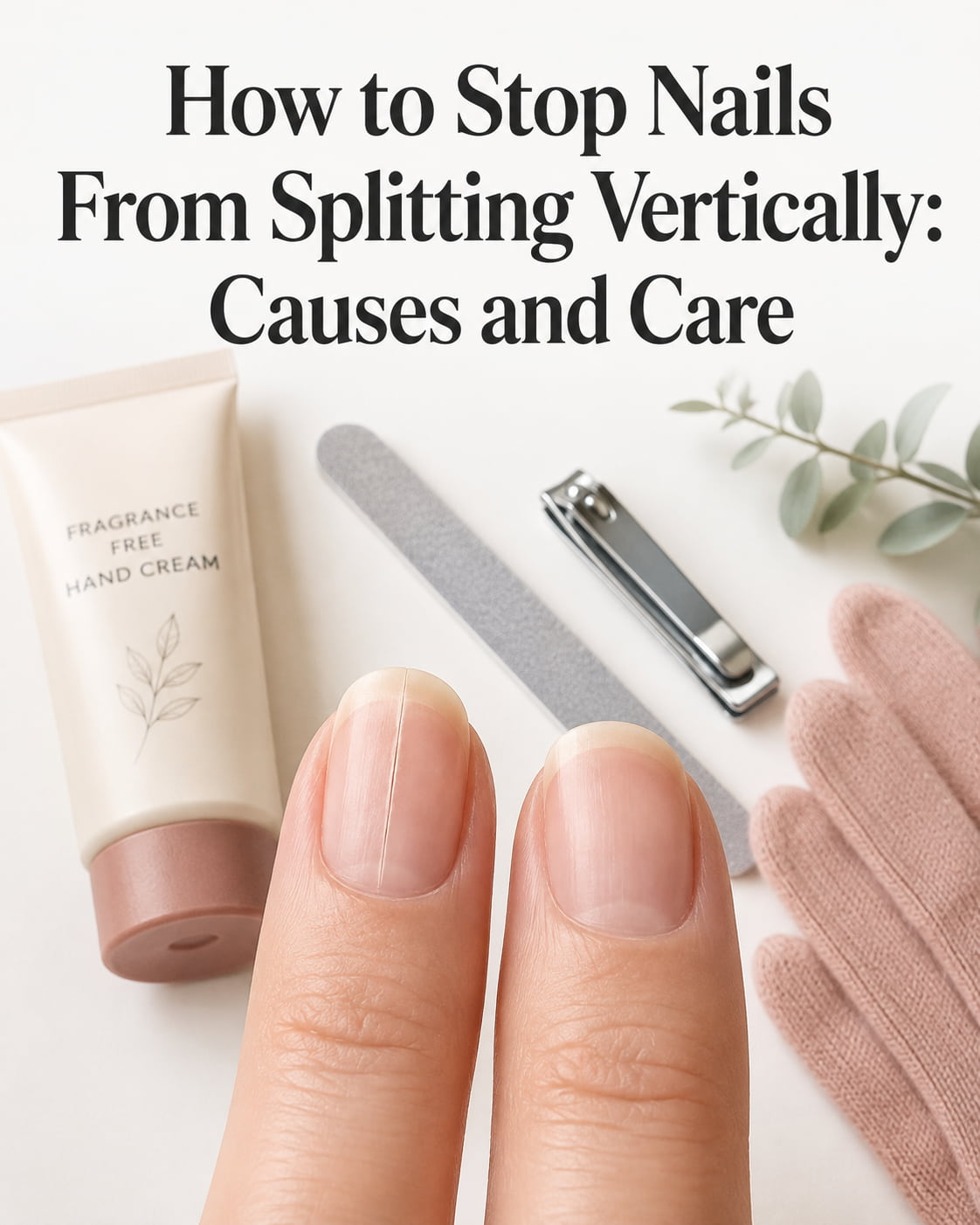
A split nail cannot permanently fuse back together. The damaged section must gradually move toward the tip as new nail grows from the base. Most mild splits improve with consistent protection, but a recurring split in the same nail may need evaluation by a dermatologist.
What Does a Vertical Split in a Nail Mean?
Vertical nail splitting is a crack or fissure that runs from the tip of the nail toward the cuticle. The medical term onychorrhexis describes lengthwise ridging and fissuring of the nail plate.
A mild raised ridge is not necessarily a split. Vertical ridges commonly become more noticeable with age. A true split creates an opening or weak line that may catch on clothing, deepen, or become painful.
Vertical splitting is also different from onychoschizia, which causes thin layers to peel across the free edge of the nail. According to DermNet, layered peeling is frequently associated with water and detergent damage, while lengthwise splitting can also occur with psoriasis, fungal nail infection, or lichen planus.
How to Stop Nails From Splitting Vertically
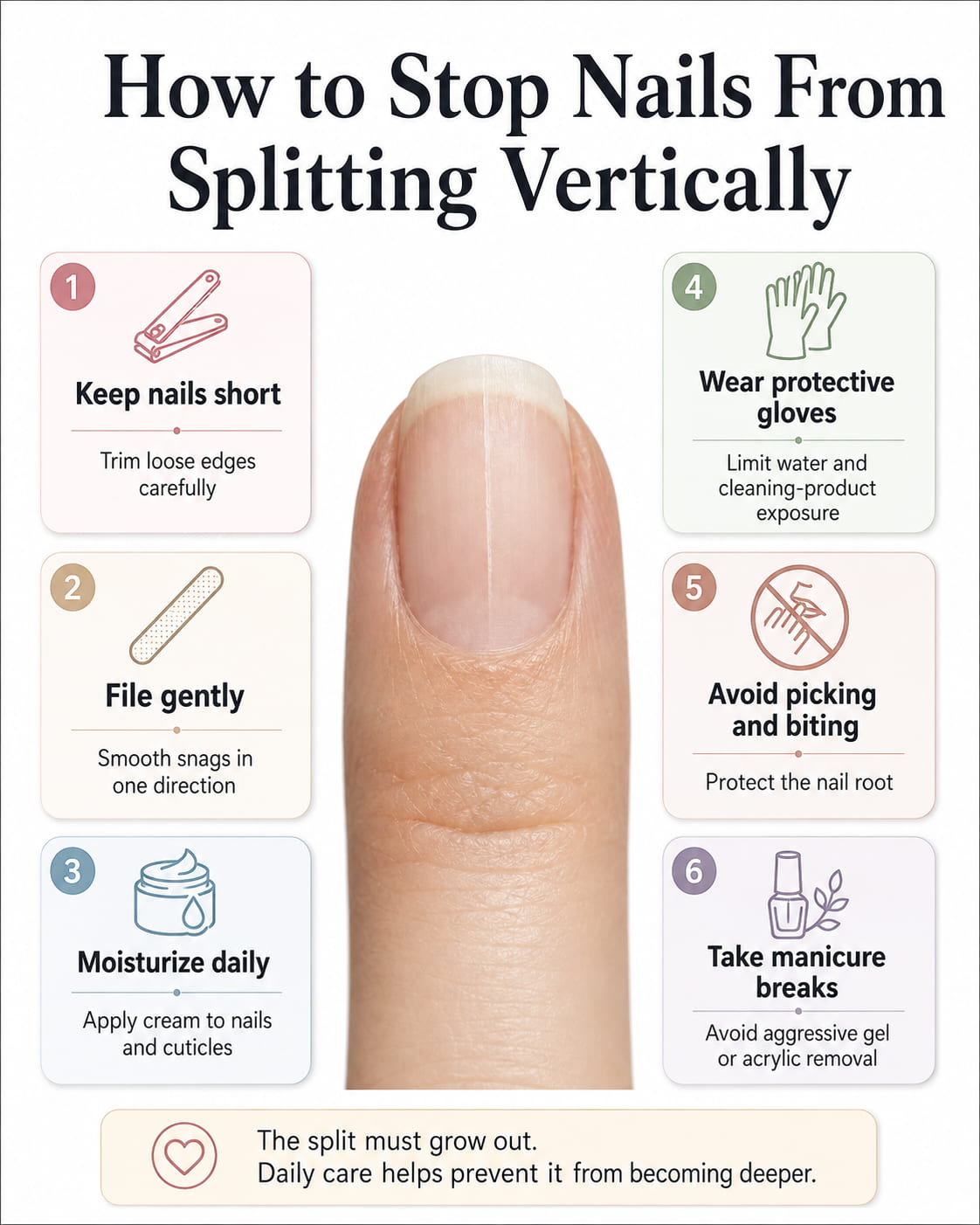
The following steps reduce stress on the nail and help prevent a small split from becoming deeper.
1. Keep the Nail Short and Smooth
Long nails are more likely to bend, snag, and reopen along a weak vertical line.
Use clean, sharp nail clippers to cut the nail almost straight across. Slightly round the corners with a fine nail file so they do not catch on clothing.
When filing:
- File gently in one direction.
- Smooth only rough or loose edges.
- Do not saw aggressively back and forth.
- Never cut into the pink, attached part of the nail.
- Do not tear away a loose section.
The American Academy of Dermatology recommends keeping nails free of snags, leaving the cuticles alone, and moisturizing after trimming to maintain flexibility.
2. Moisturize the Nails and Cuticles Daily
Dry nails are less flexible and more likely to crack along existing ridges.
After washing your hands, rub a thick fragrance-free cream or ointment over:
- The entire nail plate
- The cuticle
- The skin around the nail
- The underside of the free edge, when accessible
Petroleum jelly is an inexpensive option, especially before bed. Moisturizing will not reconnect an existing split, but it may reduce dryness and make the new nail less prone to breaking.
For very dry hands, apply petroleum jelly or a thick cream at night and wear clean cotton gloves while sleeping.
3. Protect Your Hands From Water and Cleaning Products
Repeated or prolonged contact with water can weaken nails and contribute to splitting, peeling, and breakage. Detergents, disinfectants, and household cleaners may worsen the problem.
Wear cotton-lined rubber, vinyl, or nitrile gloves when:
- Washing dishes
- Cleaning bathrooms or kitchens
- Gardening
- Handling detergents
- Working with solvents
- Doing any task that keeps your hands wet
Replace gloves if water gets inside, and dry your hands completely afterward. Dermatologists also advise protecting nails from excessive water and moisturizing after handwashing.
4. Stop Repeated Trauma to the Nail
Small, repeated injuries can damage the nail plate or the nail matrix—the growth center beneath the skin at the base of the nail.
Avoid:
- Biting or picking your nails
- Picking or cutting your cuticles
- Using nails to open containers
- Scraping labels or surfaces with your nails
- Cleaning under nails with sharp tools
- Pulling off hangnails
- Peeling off gel, dip powder, or artificial nails
- Aggressive filing or buffing
- Repeatedly pressing or rubbing the skin at the base of the nail
Cuticles help seal and protect the nail root. Mayo Clinic advises against cutting or damaging them because doing so can increase the risk of infection and new nail damage.
5. Reduce Harsh Nail Treatments
Take a break from manicures when the nail is actively splitting, sore, thin, or peeling.
Frequent polish removal—especially with strong solvents—can increase dryness. When using remover, choose an acetone-free product when possible and moisturize afterward.
Do not cover a thickened, discolored, painful, or unexplained split with acrylic, gel, or dip powder. Cosmetic coatings can hide changes that may need medical evaluation.
6. Consider a Protective Nail Hardener
A clear nail hardener may temporarily reduce bending in some weak nails. However, it will not correct damage to the nail root or treat psoriasis, fungal infection, or another underlying condition.
Use it only on an intact, uninfected nail. Stop if it causes burning, itching, redness, peeling, or worsening brittleness. Nail hardeners may help some weak nails but should be combined with basic protective care.
How to Care for a Nail That Has Already Split
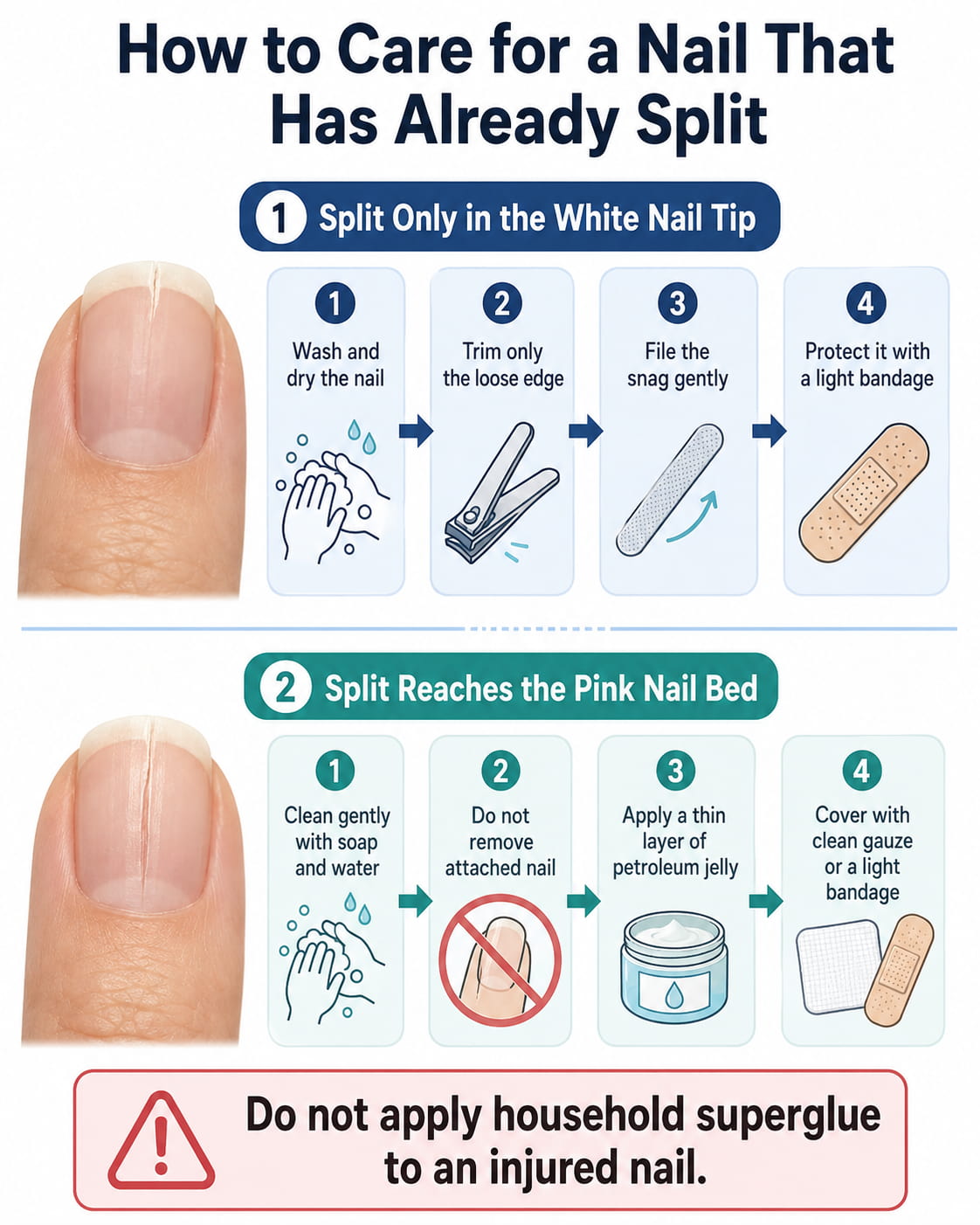
Treatment depends on whether the split is limited to the white tip or extends into the attached portion of the nail.
If the Split Is Only in the White Free Edge
- Wash your hands and dry the nail thoroughly.
- Carefully trim only the loose section that is no longer attached to skin.
- File the edge smooth so it cannot catch.
- Cover it with a small bandage during activities that may reopen it.
- Keep the nail short until the weakened area grows out.
Do not pull the split apart to see how deep it goes.
If the Split Reaches the Pink Nail Bed
A deeper split should be treated like a minor nail injury:
- Gently wash the area with soap and water.
- Do not cut or remove nail that remains attached.
- Apply a thin layer of petroleum jelly if the skin or nail bed is exposed.
- Cover it with clean gauze or a light bandage.
- Place adhesive mainly on the surrounding skin rather than directly on the injured nail.
- Change the covering daily or whenever it becomes wet or dirty.
Dermatologists recommend trimming only nail that is no longer attached, using petroleum jelly on the wound, and protecting it with a light dressing.
Should You Use Nail Glue?
Do not use household superglue on a split nail. Avoid cosmetic nail glue when the split is:
- Bleeding
- Painful
- Inflamed
- Infected
- Attached to exposed skin
- Extending into the pink nail bed
Glue does not heal the nail and may irritate the skin or make the area harder to examine. A light bandage is usually the safer temporary option.
Seek medical care after a significant injury if you cannot bend the finger, the nail turns black or purple, blood covers more than half the nail, or the pain is severe.
What Causes Nails to Split Vertically?
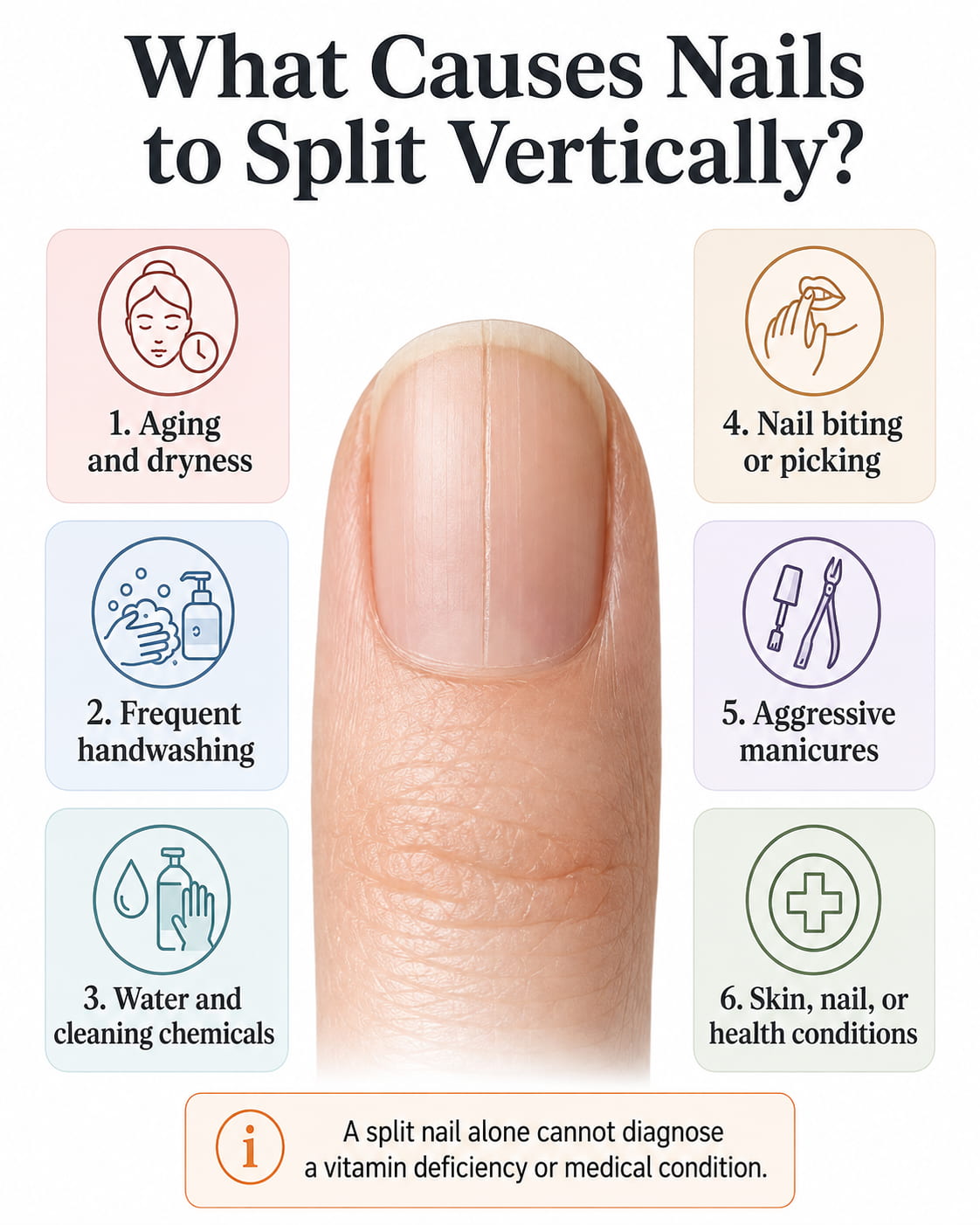
Several factors can contribute to lengthwise cracking. More than one may be present at the same time.
Aging and Dryness
Nails often grow more slowly and become more brittle with age. Lengthwise ridges may also become more visible. Mild ridging alone is usually harmless, but a dry, brittle nail may crack along one of those lines.
Repeated Water and Chemical Exposure
Frequent handwashing, prolonged soaking, detergents, solvents, and repeated wet-to-dry cycles can weaken the nail plate. Water damage more commonly causes layered peeling at the tips, but general brittleness may make an existing vertical ridge easier to split.
Injury to the Nail Matrix
The matrix produces the nail plate. Damage near the cuticle can create a weak line that continues growing along the nail.
Possible causes include:
- Picking the cuticle
- Repeatedly pushing back the skin at the nail base
- Nail biting
- Aggressive manicures
- Crush injuries
- Habitually rubbing one thumbnail
- Using the nail as a tool
When the same nail repeatedly splits along exactly the same line, local matrix damage is one possibility.
Skin and Nail Conditions
Vertical splitting may sometimes occur with:
- Nail psoriasis
- Lichen planus
- Eczema affecting the fingers
- Fungal nail infection
- Chronic inflammation around the nail
Fungal infection is more likely when the nail also becomes yellow, brown, white, thickened, crumbly, misshapen, or lifted from the nail bed. These changes can resemble other nail disorders, so examination may be needed before using antifungal treatment.
Health Conditions, Medications, and Nutritional Deficiencies
Brittle or splitting nails can sometimes be associated with thyroid disorders, low iron, low zinc, poor nutrition, or certain medications. Chemotherapy drugs and retinoids are among the medicines that can affect nail strength or growth.
However, a split nail by itself cannot diagnose a deficiency or medical condition. Aging and repeated physical damage remain common explanations.
Is Vertical Nail Splitting a Vitamin Deficiency?
It can be related to a deficiency, but this is not the most reliable explanation without other evidence.
Do not start high-dose iron or zinc solely because your nails split. Excess supplements can cause side effects and may interfere with medications or the absorption of other nutrients.
Talk with a healthcare professional about testing when splitting affects several nails or occurs with symptoms such as:
- Unusual fatigue
- Pale skin
- Hair loss
- Unexplained weight changes
- Feeling unusually cold
- Changes in bowel habits
- Ongoing weakness
- A restrictive diet or history of poor nutrient absorption
Treatment should target a confirmed deficiency rather than the appearance of the nail alone.
Does Biotin Help Splitting Nails?
Biotin is widely marketed for stronger nails, but the evidence is limited. The National Institutes of Health Office of Dietary Supplements reports that research on brittle nails consists mainly of a few small studies without placebo groups. It remains unclear whether biotin improves nails in people who are not deficient.
High-dose biotin can also produce falsely high or low results on certain laboratory tests, including some thyroid, hormone, vitamin D, and heart-related tests. Tell your doctor and laboratory staff about any biotin-containing supplements before blood testing. Do not stop a prescribed supplement without medical guidance.
How Long Does a Vertical Nail Split Take to Grow Out?
The time depends on where the split begins.
A split near the tip may grow out within several weeks. A split beginning close to the cuticle may take approximately four to six months to reach the end of the finger. The NHS notes that a completely lost fingernail generally grows back within about six months.
Improvement should appear as a smoother, stronger section of nail emerging from the base. If the new nail continues to grow with the same split, the nail matrix may still be exposed to trauma or affected by another condition.
When to See a Dermatologist
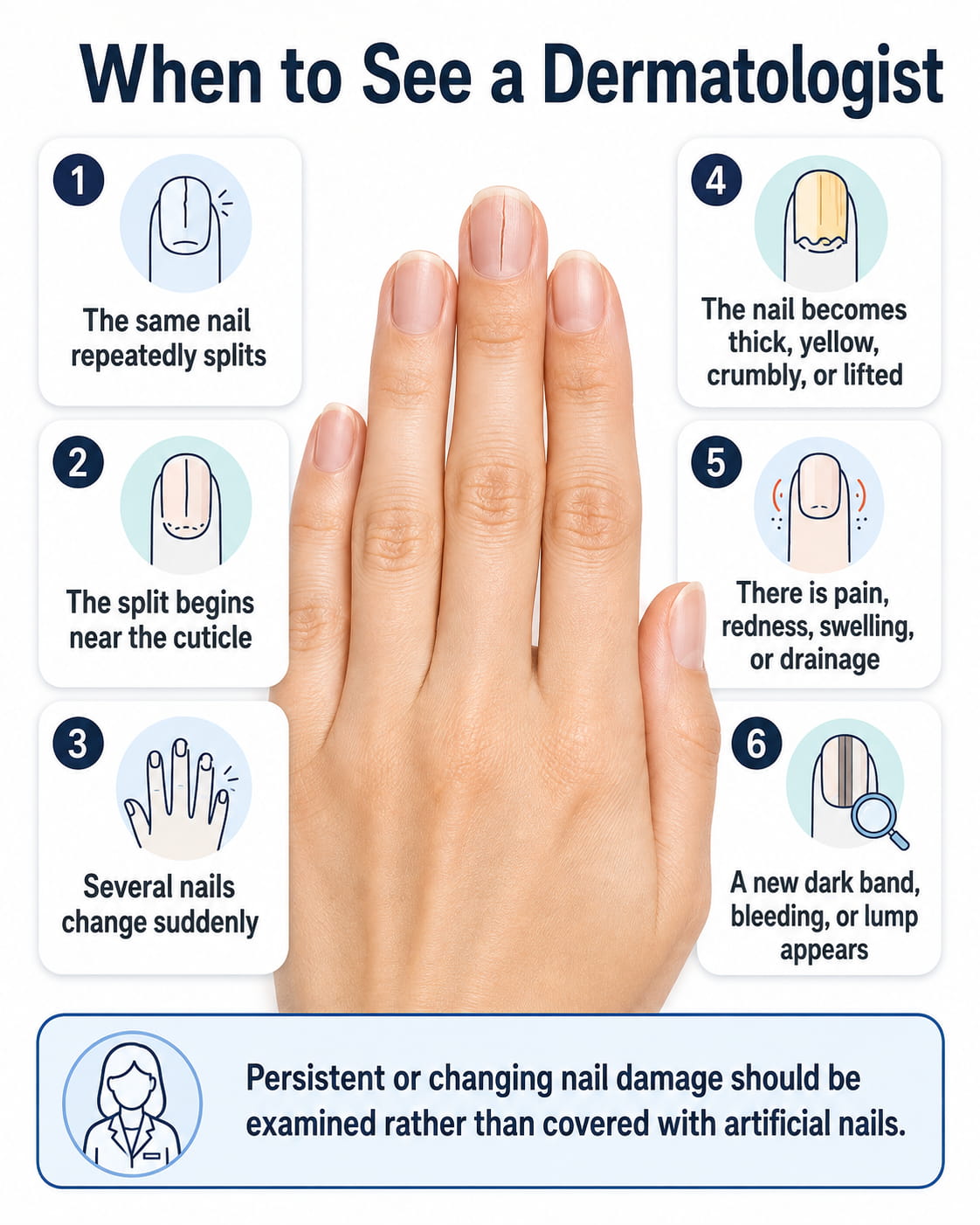
Arrange an examination when:
- The same nail repeatedly splits in the same place.
- The split begins at or close to the cuticle.
- Several nails suddenly become brittle or split.
- The problem does not improve after two to three months of careful protection.
- The nail becomes thick, yellow, brown, crumbly, pitted, or lifted.
- The surrounding skin is red, swollen, warm, painful, or draining pus.
- The split bleeds or exposes the nail bed.
- You have psoriasis, diabetes, poor circulation, or a weakened immune system.
- A medication may be affecting your nails.
Seek prompt dermatology care if a persistent split appears with a new or widening brown, black, or red band, pigment spreading onto the skin around the nail, a lump beneath the nail, unexplained bleeding, or nail lifting. Most nail changes are not cancer, but rare nail tumors—including nail melanoma—can cause splitting and should be ruled out.
Frequently Asked Questions
Can a Vertically Split Nail Heal Itself?
The split section cannot fuse back into normal nail. It must grow toward the tip and be trimmed away. Protection and moisturizing can prevent it from becoming deeper while new nail grows.
Why Does the Same Fingernail Keep Splitting Vertically?
A recurring split in one nail may result from repeated trauma, picking near the cuticle, previous matrix injury, or a localized nail condition. A dermatologist should examine a split that repeatedly follows the same line.
Does Petroleum Jelly Help Splitting Nails?
Petroleum jelly may help reduce dryness and improve nail flexibility, especially when applied to the nail and cuticle before bed. It does not reconnect an existing split.
Should I Cut Off a Vertically Split Nail?
Trim only the loose white portion that is no longer attached to skin. Do not cut into the pink nail bed or pull away nail that remains attached.
Can Gel or Acrylic Nails Fix a Vertical Split?
They may temporarily hide the damage but do not treat its cause. Covering an unexplained, painful, discolored, or infected split may delay evaluation and can add more stress during removal.
What Deficiency Causes Nails to Split?
Low iron or zinc can contribute to brittle nails, but splitting alone does not confirm a deficiency. Thyroid conditions, aging, dryness, trauma, skin disease, and nail infection are other possibilities.
How Can I Prevent My Nail From Splitting in the Same Place?
Keep it short, file snags gently, moisturize daily, wear gloves during wet work, leave the cuticle alone, and stop any habit that presses or picks at the nail base. Seek an examination if healthy nail does not begin growing from the base.
Conclusion
Most vertically splitting nails improve when you reduce water exposure, moisturize consistently, keep the nail short, and stop repeated trauma. Start with gentle daily care and protect the split until it grows out.
A split that repeatedly returns, changes color, becomes painful, or grows from the base deserves a dermatologist’s attention rather than continued cosmetic covering.
This content is for informational purposes only and not medical advice.