

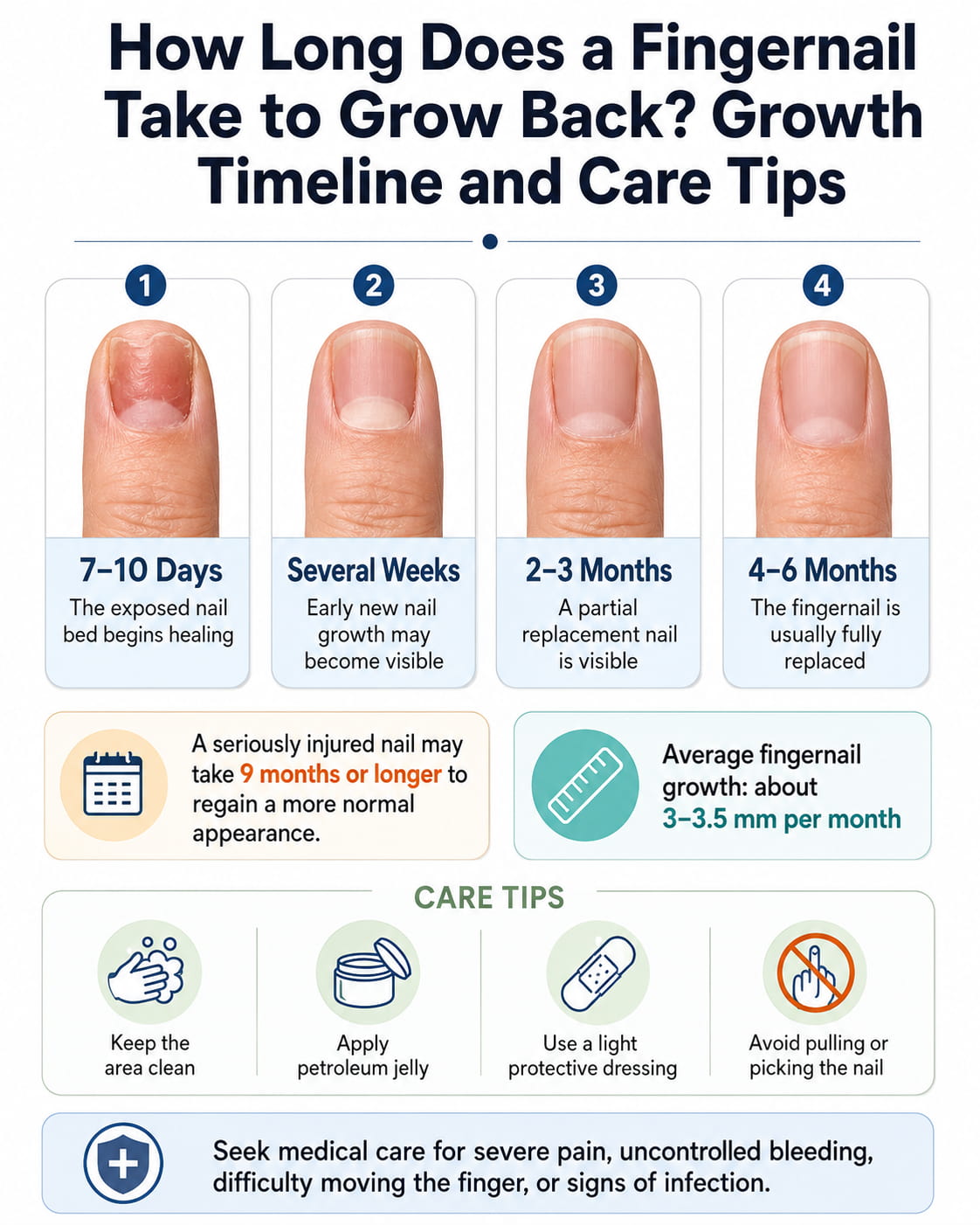
A fingernail usually takes about 4–6 months to grow back completely after it falls off or is removed. Fingernails grow slowly—about 3 millimeters per month—so the nail bed may heal long before the new nail reaches the fingertip.
The exact timeline depends on how much of the nail was lost and whether the nail bed or nail-producing tissue was damaged. Most nails return, but a serious injury can cause temporary ridges, an uneven shape, or permanent changes.
How Long Does a Fingernail Take to Grow Back?
For most people, complete fingernail replacement takes approximately four to six months. The National Library of Medicine’s MedlinePlus states that the exposed nail bed may heal within 7–10 days, even though the new nail needs several additional months to grow out.
A typical recovery may look like this:
| Stage | Approximate time |
|---|---|
| Nail-bed wound begins healing | 7–10 days |
| Early nail growth becomes noticeable | Several weeks |
| A partial new nail is visible | 2–3 months |
| Complete fingernail replacement | 4–6 months |
| Appearance continues improving after a serious injury | Up to 9 months or longer |
These times are estimates rather than deadlines. Some nails grow faster or slower, and a severely injured nail may need longer to regain a normal appearance.
How Fast Do Fingernails Grow?
Healthy fingernails generally grow about 3–3.5 millimeters per month, or roughly 0.1 millimeter per day. Research measuring nail growth in healthy adults found an average rate of approximately 3.47 millimeters per month.
This means that visible progress can seem slow, especially during the first few weeks. A nail begins growing beneath the skin at its base, so some new growth occurs before you can see it.
Fingernails also grow considerably faster than toenails. A lost toenail may require 12–18 months to grow back, while a fingernail commonly returns within six months.
Fingernail Regrowth Timeline
The First 7–10 Days
The exposed nail bed starts closing and healing. The area may remain tender, sensitive, or uncomfortable when touched.
Protecting the fingertip is especially important during this stage because the missing nail is no longer shielding the tissue underneath.
The First Month
The skin should continue healing, and a small amount of new nail may begin appearing at the base. You might not notice much progress because the nail grows from beneath the skin near the cuticle.
Pain and swelling should generally improve. Increasing pain, warmth, redness, or drainage is not part of normal healing and should be medically evaluated.
Two to Three Months
A larger portion of the replacement nail should be visible. After a significant nail-bed injury or repair, the new nail may initially appear ridged, bumpy, thick, or uneven.
The Chelsea and Westminster Hospital NHS Foundation Trust notes that a new but abnormal-looking nail may be present around three months after nail-bed repair.
Four to Six Months
The nail plate usually reaches the fingertip, completing the main regrowth process. The NHS also advises that fingernails lost after an injury should generally grow back within six months.
However, the nail’s color, thickness, surface, or shape may continue improving after it has reached full length.
Six to Nine Months and Beyond
Following a deep nail-bed injury, the replacement nail may need additional time to look more like the original. Some hospital guidance estimates that a more normal-looking nail may take around nine months to develop after surgical nail-bed repair.
Will a Fingernail Grow Back After Falling Off?
In most cases, yes. A fingernail can grow back after falling off because of:
- A crushed or slammed finger
- A sports injury
- Repeated pressure or friction
- A collection of blood beneath the nail
- An infection
- Surgical nail removal
The new nail commonly grows underneath the damaged nail and gradually pushes the old nail forward. Sometimes the damaged nail stays partly attached until the replacement nail forces it off.
The outcome depends heavily on the condition of the nail matrix.
What Is the Nail Matrix?
The nail matrix is the growth center beneath the skin at the base of the nail. It produces the cells that become the hard nail plate.
When the matrix remains intact, the fingernail can usually grow back. When it has been deeply cut, crushed, or scarred, the new nail may:
- Develop permanent ridges
- Split as it grows
- Become thicker or uneven
- Grow in an unusual direction
- Grow only partially
- Occasionally fail to return
A serious injury does not automatically mean permanent damage. The first replacement nail may look irregular and then improve during later growth cycles.
Why Is My New Fingernail Growing Back Bumpy?
Ridges, grooves, bumps, or an uneven surface are common after a significant nail injury. They can develop because the injury temporarily interrupted nail production or damaged the tissue supporting the nail.
A bumpy replacement nail may gradually smooth out as the injured area heals and newer nail material grows forward. However, permanent scarring in the nail matrix can cause lasting changes.
Consider seeing a dermatologist or hand specialist when:
- The nail repeatedly splits in the same place
- Growth appears to stop
- The new nail is severely distorted
- The surrounding skin remains painful or swollen
- Several nails change without a clear injury
- A dark streak does not grow outward with the nail
Changes affecting several nails may have causes unrelated to the original injury and deserve professional evaluation.
What Can Slow Fingernail Regrowth?
Fingernail growth varies naturally. Factors that may delay recovery include:
Severe Damage
A small chip grows out faster than a nail that has been completely torn away. Crush injuries may also damage the nail bed, matrix, fingertip bone, or surrounding skin.
Repeated Trauma
Picking at the nail, biting it, using it as a tool, or repeatedly catching it on objects can reopen the injury and interfere with smooth growth.
Infection
Bacterial or fungal infections may affect the nail bed and change the nail’s color, thickness, attachment, or growth pattern.
Age
Nails tend to grow more slowly and become more brittle with age.
Health Conditions or Medications
Some skin conditions, illnesses, nutritional deficiencies, and medications can alter nail appearance or growth. The NHS lists psoriasis, iron-deficiency anemia, thyroid disorders, diabetes, and some medicines among possible causes of nail changes.
A slow-growing nail alone does not confirm any medical condition. A clinician should evaluate persistent changes, especially when several nails are affected.
How to Care for a Fingernail While It Grows Back
Home care may be appropriate for a mild nail injury. Serious cuts, crush injuries, or partially amputated fingertips require professional treatment.
The American Academy of Dermatology recommends the following steps for a minor injured nail.
1. Trim Only the Loose Portion
If part of the nail is hanging off, carefully trim only the section that is no longer attached to the skin.
Do not pull the nail away. Pulling can tear healthy tissue or worsen an injury beneath the nail.
2. Clean the Area Gently
Wash the injury with mild soap and water. Avoid scrubbing the exposed nail bed or using sharp objects beneath the remaining nail.
3. Apply Petroleum Jelly
A thin layer of petroleum jelly can keep the wound moist and reduce sticking. Cover it with clean gauze or a light bandage.
Place adhesive on the surrounding skin rather than directly over the injured nail whenever possible.
4. Protect the Fingertip
Continue using a light dressing after the bleeding has stopped if the fingertip is sensitive or likely to be bumped.
Change the dressing when it becomes wet, dirty, or loose. Avoid wrapping it so tightly that the fingertip becomes numb, cold, pale, or blue.
5. Reduce Swelling
Use a cool, damp cloth and elevate the hand above heart level. This may reduce throbbing and swelling during the early stage.
An over-the-counter pain reliever may help when it is safe for you. Follow the product label, and ask a healthcare professional before using it if you have kidney disease, stomach ulcers, bleeding problems, or other relevant medical conditions.
6. Avoid Manicures and Artificial Nails
Do not cover an actively healing nail bed with polish, gel, acrylic, press-on nails, or nail glue. These products may irritate the area, trap moisture, hide infection, or cause further trauma during removal.
Wait until the skin has healed and the new nail is firmly attached.
Can You Make a Fingernail Grow Back Faster?
There is no proven home remedy that makes a fingernail regrow dramatically faster. The most useful approach is to create conditions that allow normal growth:
- Protect the nail matrix from additional injury
- Keep the area clean
- Avoid picking or biting
- Moisturize the surrounding skin after the wound closes
- Wear gloves during wet work or cleaning
- Eat a varied, balanced diet
- Address infections or medical conditions promptly
Products marketed as nail-growth serums generally cannot change how quickly the matrix produces nail cells. They may reduce dryness or breakage, which can help the growing nail remain intact, but they do not replace time.
Does Biotin Help Nails Grow Faster?
Biotin is commonly promoted for hair and nails, but evidence is limited. The National Institutes of Health Office of Dietary Supplements reports that claims about stronger nails are based mainly on a few small studies without placebo groups. More research is needed, particularly in people who do not have a biotin deficiency.
High-dose biotin can also interfere with certain blood tests, including some thyroid, hormone, vitamin D, and heart-related tests. Tell your healthcare professional about any biotin-containing supplement before laboratory testing.
When Should You See a Doctor?
Seek prompt medical care when:
- You cannot bend or move the injured finger normally
- Blood covers more than half of the nail
- The nail becomes black or purple after a painful injury
- The nail has been deeply cut or torn away
- The fingertip was crushed
- Bleeding will not stop
- Pain is severe or worsening
- A fracture may be present
The American Academy of Dermatology recommends medical evaluation for a very painful injury, a black or purple nail, blood covering more than half the nail, or difficulty bending the finger.
Contact a healthcare professional if infection signs develop, including:
- Increasing redness
- Increasing swelling
- Warmth around the injury
- Pus or foul-smelling drainage
- Fever
- Worsening pain
MedlinePlus specifically recommends contacting a medical provider when redness, pain, or swelling increases, pus appears, fever develops, or bleeding does not stop.
Frequently Asked Questions
How long does a fingernail take to grow back after falling off?
A completely lost fingernail normally takes about 4–6 months to grow back. The exposed nail bed may heal within 7–10 days, but the nail plate grows much more slowly.
When will I first see the new fingernail?
You may notice new nail emerging near the cuticle within several weeks. The exact timing depends on where the nail broke and whether swelling or remaining nail material hides the early growth.
Will a fingernail grow back after being completely removed?
It usually will when the nail matrix remains healthy. Deep damage or scarring at the nail base can cause abnormal, partial, or absent regrowth.
Why is my fingernail growing back with ridges?
Ridges can occur when an injury temporarily disrupts nail production. They may move toward the fingertip and disappear as the nail grows, but severe matrix damage can cause permanent ridging.
Should I cover a missing fingernail?
A light, clean dressing can protect the sensitive nail bed, especially during early healing. Apply petroleum jelly first to reduce sticking, and avoid placing adhesive directly over the injury.
Can biotin make my fingernail grow back faster?
There is not enough strong evidence to show that biotin significantly speeds nail regrowth in healthy people. High-dose supplements can interfere with medical laboratory tests.
What happens if my nail is not growing back?
Early growth may be difficult to see because the nail begins beneath the skin. See a dermatologist or hand specialist if no growth becomes visible after several months, the area remains painful, or the replacement nail is severely distorted.
Conclusion
A lost fingernail usually grows back, but patience is essential. Expect approximately 4–6 months for full regrowth, and potentially longer for the nail to look normal after a deep nail-bed injury.
Keep the fingertip clean, lightly covered, and protected from additional trauma. Seek medical care for severe pain, restricted movement, uncontrolled bleeding, infection signs, or an injury involving a large area beneath the nail.
This content is for informational purposes only and not medical advice.